
Voter Education Series – Judicial Review: What It Means, Its Origin, and How It Impacts Our Community

Updated: Sep 17

Quick Look: Judicial Review & Its Role in Your Democracy
Judicial review is the power of courts to nullify laws that violate the Constitution — and it has a direct impact on the rights you exercise every single day.
Most voters pay attention to elections, but judicial review is often where the real decisions about your freedoms are made.
There is a crucial distinction between judicial review and judicial activism — and confusing the two results in significant misunderstandings about how courts should behave.
Courts can actually enhance democracy by protecting your ability to make choices beyond just casting a vote — including where you live, work, and raise your family.
Later in this article, we unpack the “foot voting” concept that challenges everything you thought you knew about democratic power.
Most people believe democracy starts and stops at the ballot box — but the courtroom may be where your freedoms are actually determined.
Getting to grips with judicial review is one of the most useful things a voter can do. It can help you understand why laws are sometimes overturned, why courts appear to have so much influence, and how the Constitution remains pertinent hundreds of years after it was penned. Resources such as those available through civics education platforms aim to bridge the gap between what citizens are aware of and what they need to be aware of to participate effectively in democracy.
Judicial Review Shapes Every Law You Live Under
Every law passed by Congress, every executive order given by a president, and every rule made by a federal agency exists under one condition: they cannot go against the Constitution. Judicial review is the tool that enforces this condition. Without it, elected officials could make almost any law they wanted, with no limit on their power.
Consider what this means in everyday life. The laws that protect your right to free speech on the internet, your right to gather, your protections against illegal searches — all of these have been formed, explained, or defended by judicial review at some point in the history of the United States.
The Constitution doesn't provide the only definition of your First Amendment rights; landmark court decisions have also played a role.
Courts reviewing the extent of their power have helped set the limits within which federal agencies like the EPA or FCC operate.
This process has resulted in state laws on everything from voting access to housing being struck down or upheld.
The courts can review even presidential actions during national emergencies for constitutionality.
This isn't just abstract legal theory. These are the rules that dictate how you live your life every day, and judicial review is how those rules are checked against the nation's founding document.
The Simple Definition of Judicial Review
Judicial review is the power of a court, particularly the U.S. Supreme Court, to scrutinize laws and government actions to see if they align with the Constitution. If a law is deemed unconstitutional, the court can nullify it, essentially making it unenforceable. It doesn't matter whether a law is good or bad. The only thing that matters is if it violates the Constitution.
The Unseen Impact of Judicial Appointments
While elections draw the lion's share of public attention, the nomination and appointment of judges can have a far more enduring impact on citizens' rights. A president's term lasts four to eight years, but a Supreme Court justice can serve for a lifetime. The decisions they make can influence the interpretation of the Constitution for many years to come. By understanding the concept of judicial review, voters can appreciate that their influence extends beyond the ballot box. They also need to be aware of who nominates and approves the individuals who wield such immense power.
Understanding the Main Goal of Judicial Review in a Democratic Society
The main goal of judicial review is to give the Constitution substance. A written constitution is only as powerful as the system that upholds it. The system that upholds it is judicial review. It guarantees that the document the people ratified in 1788 and have amended 27 times since actually governs the government's behavior, not the other way around.
For a democracy to work properly, the majority should be able to legislate. However, the majority should not infringe on the rights of the minority in the process. This is the delicate balance at the core of constitutional governance, and judicial review is the main mechanism for maintaining it. Courts act as a structural barrier between transient political majorities and enduring constitutional safeguards.
Judicial review protects minority rights from majority overreach.
It maintains the separation of powers between the three branches of government.
It ensures federal law remains supreme over conflicting state laws, per the Supremacy Clause.
It gives citizens a legal avenue to challenge government actions that violate their rights.
How Courts Act as a Check on Elected Officials
The framers of the Constitution were deeply suspicious of concentrated power. That is why they built a system of checks and balances. Congress checks the president through legislation and oversight. The president checks Congress through the veto. And the judiciary checks both by reviewing whether their actions comply with the Constitution. Courts are the only branch specifically designed to be insulated from direct political pressure — federal judges are appointed, not elected, and serve for life precisely so they can make unpopular decisions when the Constitution demands it.
The independence of the judiciary is both a strength and a point of contention in the context of judicial review. Critics argue that judges, who are not elected officials, should not have the power to overturn the decisions of elected lawmakers. Supporters, however, argue that this independence is what gives the judicial check on power its strength.
Judicial Review vs. Judicial Activism: What's the Difference?
Although they're often used interchangeably, judicial review and judicial activism are not the same. Judicial review is a power — the ability to determine if laws are constitutional. On the other hand, judicial activism is a criticism — a claim that a court is overstepping its boundaries and making policy decisions that should be made by elected officials. It's possible to support the institution of judicial review while critiquing specific decisions as an activist. Understanding the difference between these two terms is crucial for any truthful discussion about the courts.
The Source of Judicial Review's Power
Fascinatingly, the Constitution does not directly mention the power of judicial review. This power was established in the notable 1803 case Marbury v. Madison, where Chief Justice John Marshall stated that it is “emphatically the province and duty of the judicial department to say what the law is.” This decision has not been seriously disputed, and for over 220 years, judicial review has been a fundamental aspect of American constitutional law.
Traditional Voting and Foot Voting: Two Methods of Democratic Participation
Most people consider voting in elections as the primary way to exercise political power. However, experts have highlighted another significant form of democratic participation: voting with your feet. This involves making decisions about where to live, work, and organize your life based on the laws and policies of different jurisdictions. Interestingly, this kind of “foot voting” can provide individuals with more direct influence over the policies that govern them than casting a single vote in a national election.

Law expert Ilya Somin has argued that foot voting often leads to more educated and independent political decisions than ballot-box voting. When you decide to move to a state due to its tax policy, education system, or regulatory environment, you are making a conscious, high-stakes choice. That level of involvement and impact tends to lead to more considered decisions than casting one vote among millions, where your individual ballot has almost no chance of determining the result.
Voting at the polls: One vote among millions, indirect influence, outcome determined by the majority.
Moving between states: Choosing which state or locality to live in based on its governance and policies.
Choosing private sector options: Choosing employers, communities, and institutions based on rules and values.
International migration: Moving across national borders to access better governance or opportunity.
Why Your Single Vote Rarely Decides an Election
This isn't an excuse to stop voting. Rather, it's an opportunity to understand the full scope of political power. In most large elections, the statistical probability that your single vote changes the outcome is extraordinarily small. This is a mathematical reality, not a political opinion. The value of voting comes from collective participation and civic expression, not from individual decisive impact.
On the other hand, foot voting has a direct and immediate impact on your life. If you decide to move from a state with high taxes to one with low taxes, that decision takes effect immediately and entirely because of your individual choice. There is no need for a majority coalition. There is no need to wait for an election cycle. The choice is yours, and the impact is immediate.
That's why judicial review is so crucial to the idea of foot voting. Courts safeguard the structural constraints on federal power, thereby preserving the diversity of state and local policies that initially give foot voting its significance. If the federal government had the power to regulate everything uniformly, there would be no differences between jurisdictions to choose from.
Understanding Foot Voting and Its Power
Foot voting is the conscious decision to choose where you live, work, or participate based on the policies and governance of different jurisdictions. When a family moves from one state to another because of better schools, lower taxes, or more favorable regulations, that is foot voting. It is a form of democratic participation that is direct, personal, and has immediate consequences, unlike casting a ballot in a national election.
Foot voting comes in three primary forms, each at a different scale. Interstate foot voting is when people move from state to state in the U.S. to take advantage of different policy environments. Private sector foot voting is when people choose employers, communities, or private institutions based on the rules and culture of those organizations. International foot voting is when people cross national borders in search of better governance, safety, or economic opportunity. Each of these requires a degree of available choice — and judicial review plays a direct role in protecting and preserving that choice.
How Judicial Review Safeguards Your Right to Vote With Your Feet
For foot voting to be effective, there need to be actual differences between jurisdictions. If the federal government has unrestrained power to regulate every aspect of life uniformly across all 50 states, there's nothing left to choose between them. Judicial review, by upholding constitutional limits on federal power — especially through Commerce Clause jurisprudence — aids in maintaining the policy diversity that allows interstate foot voting to be a real choice for American citizens.
The courts also play a role in safeguarding the right to vote by upholding individual rights related to mobility and freedom of choice. For instance, the Supreme Court has acknowledged the right to travel between states as a constitutional right. When courts overturn laws that limit where individuals can relocate or what options they can pursue, they are actively preserving the conditions that allow for foot voting. This is one of the most overlooked ways in which robust judicial review bolsters — rather than diminishes — democratic freedom.
How Judicial Review Safeguards Personal Freedoms
In addition to its structural role in maintaining the balance of power, judicial review is the primary means by which individual constitutional rights are upheld in the United States. The Bill of Rights does not enforce itself. Without courts ready to review government actions against those standards, the rights listed in the Constitution would be little more than suggestions. It is the practice of judicial review that turns those words into enforceable protections.
It is essential for individuals who are part of political minorities. Democracy is founded on the principle of majority rule, but it is not without its boundaries. A majority cannot deprive a disliked group of its right to free speech. A majority cannot permit unreasonable searches simply because most people are unaffected.
Judicial review is the tool that enforces these boundaries, guaranteeing that everyone has rights, not just those who are politically influential at any given time.
The Importance of Free Speech and Press Freedom in Making Informed Choices
In order for democracy to function effectively, it is essential that its citizens are well-informed. And for citizens to be well-informed, they must have freedom of speech and the press. The role of judicial review in defining the extent of First Amendment protections has been crucial. It has protected political speech that the government may find inconvenient, limited the government's ability to prevent the press from publishing, and defined the boundaries of speech that incites violence. These are not merely theoretical legal issues. They directly affect what information you can access and what opinions you can voice without fear of punishment from the government.
Restrictions in the Constitution That Hinder Government Overstepping Crucial Constitutional Restrictions Upheld Through Judicial Review
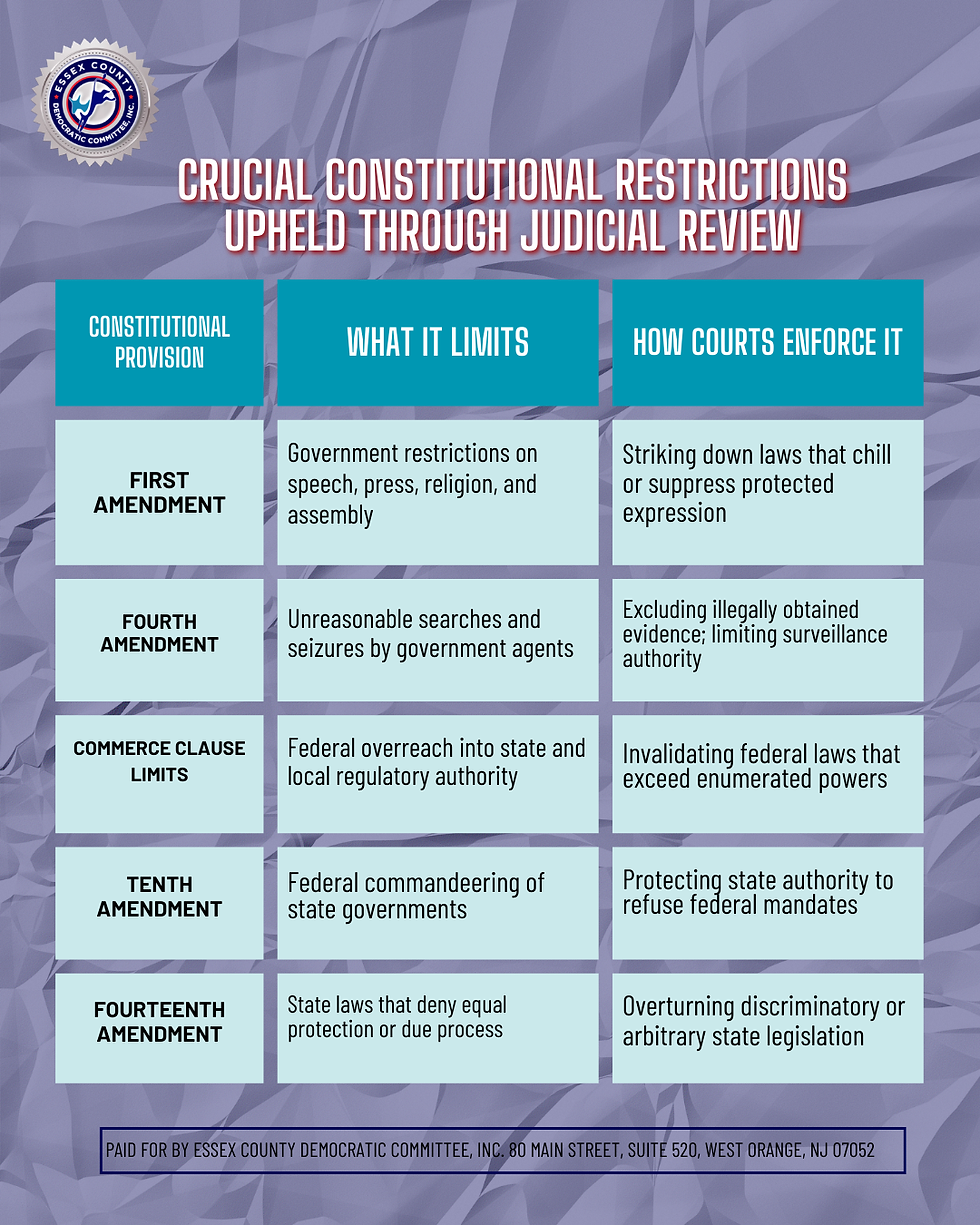
Each of these constitutional provisions only has real bite because courts are willing to review government conduct against them. Without judicial review, these protections would exist on paper with no practical enforcement mechanism. The table above illustrates just how broad the scope of constitutional limits actually is — covering everything from what law enforcement can do in your home to how much authority Washington can exercise over your state.
The Commerce Clause cases are especially significant for understanding how judicial review upholds the federal balance. Throughout most of the 1900s, the courts construed Congress' power to regulate interstate commerce so broadly as to legitimize nearly all federal laws. It was not until cases such as United States v. Lopez (1995) and United States v. Morrison (2000) that the Supreme Court began to impose substantial restrictions on that power once more, indicating that the Commerce Clause does not provide the federal government with unlimited authority.
These decisions have a direct impact on the lives of ordinary citizens because they decide which level of government - federal, state, or local - sets the rules they must follow. The closer the decision-making authority is to the people it affects, the more likely it is to respond. Therefore, judicial review that enforces federalism limits is not just a legal technicality. It is a method of ensuring that the government is accountable to the people it governs.
Is Judicial Review a Threat to Democracy? The Ongoing Debate
The argument is simple and deserves to be taken seriously: in a democracy, people should govern themselves through their elected representatives. When unelected judges overturn laws passed by elected lawmakers, they appear to substitute their own judgment for the will of the people. This tension between judicial power and democratic self-government is one of the oldest debates in American constitutional law, and it has not been resolved — it has only become more heated. For further insight, explore the discussion on whether democracy and judicial review are truly incompatible.
Arguments Against Judicial Review
In The People Themselves: Popular Constitutionalism and Judicial Review (2004), Larry Kramer, among other legal scholars, and Jeremy Waldron, in his influential Yale Law Journal article The Core of the Case Against Judicial Review (2006), contend that judicial review is fundamentally at odds with democratic principles. They argue that there is no valid reason why nine unelected judges should have the ultimate authority over constitutional interpretation in a society of reasonable people who have differing opinions about rights. Mark Tushnet, in Taking the Constitution Away from the Courts (1999), takes this argument a step further, advocating for the return of constitutional interpretation to the political branches in their entirety.
These are not just fringe positions. They are serious arguments made by serious legal thinkers. The concern is not just philosophical. When courts strike down popular legislation — on gun control, immigration, campaign finance, or economic regulation — large segments of the public experience that as a direct denial of their democratic will. That frustration is real, and it feeds cycles of political backlash that can destabilize confidence in the judiciary as an institution.
How Robust Judicial Review Can Actually Bolster Democracy
The counterpoint is just as persuasive. Voting at the ballot box is merely one form of democratic self-rule, and it is often not the most effective. When judicial review enforces constraints on centralized federal authority, it broadens the scope of policy climates that citizens can select from — empowering foot voters and making democratic engagement more significant, not less. When courts safeguard freedom of speech, assembly, and press, they preserve the very conditions that make electoral democracy operational in the first place. A democracy devoid of these protections is not more democratic — it is more susceptible.
Common Ground Between Originalists and Progressive Critics
At first glance, it might appear that originalists, who believe that courts should adhere strictly to the Constitution's original meaning, and progressive critics of judicial review, have no common ground.
However, both groups are actually concerned about judicial overreach. Originalists are concerned that courts may create new rights that are not included in the Constitution. Progressive critics are concerned that courts may use judicial review to overturn economic regulations and social legislation. Despite their political differences, both groups are essentially making the same argument: judges should not make policy decisions that elected officials should.
But the solutions they propose are different. Originalists believe that courts should adhere strictly to the Constitution's text and historical interpretation. Progressive critics, on the other hand, often argue that courts should defer more broadly to legislative majorities. Neither viewpoint fully resolves the problem of democratic legitimacy because both still require judges to make difficult interpretive decisions about the scope of their own authority. This is why the debate over judicial review will probably never be completely resolved — it reflects a real tension inherent in the structure of constitutional democracy itself.
The Role of Judicial Review in Federal, State, and Local Government
Judicial review is not a one-size-fits-all process. It operates at all levels of government and in all directions. Federal courts review federal laws, while state courts review state laws. The U.S. Supreme Court, however, has the power to review both federal and state laws, but only when a constitutional issue is at stake. This is a reflection of the federal structure of the U.S. government, which divides authority both vertically, between the national and state governments, and horizontally, between the three branches of government at each level. By understanding where each layer of review operates, voters can better understand which court decisions directly impact their lives at the local level, which often have a more immediate effect than any decisions made in Washington.
How the Courts Keep Federal Power in Check
The Commerce Clause of the U.S. Constitution gives Congress the power to regulate commerce “among the several states.” For decades, this clause was interpreted so broadly that it functioned as an almost unlimited grant of federal legislative authority. Judicial review changed that. When the Supreme Court ruled in United States v. Lopez (1995) that the Gun-Free School Zones Act exceeded congressional Commerce Clause authority, it marked the first time in nearly 60 years that the Court had struck down a federal law on those grounds. That decision was not just a legal milestone — it was a reassertion that constitutional limits on federal power are real and enforceable.
When federal regulations go beyond what is constitutionally permissible, courts can invalidate them.
Through judicial review, the Tenth Amendment ensures that powers not given to the federal government are reserved for the states or the people.
The anti-commandeering doctrine, established in cases such as Printz v. United States (1997), stops the federal government from forcing state officers to carry out federal programs.
Spending power limits, developed through cases like NFIB v. Sebelius (2012), limit how the federal government can use financial incentives to pressure states into compliance.
Each of these legal doctrines is a result of judicial review. Without courts that are willing to enforce them, the line between federal and state authority would be determined solely by political negotiation. History has shown that when there are no constitutional guardrails, federal power tends to prevail in these negotiations.
That's why the role of courts in checking federal power is more than a mere technicality of federalism. It directly impacts whether the government that is closest to you — your city council, your state legislature — maintains significant power over the matters that influence your everyday life. As federal authority grows unchecked by the Constitution, local accountability diminishes. One of the main tools to prevent this from happening is judicial review.
What Occurs When States Exceed Their Power
Judicial review isn't a one-way street. Just as courts rein in federal overreach, they also nullify state laws that contravene the Constitution. The Fourteenth Amendment — which forbids states from denying anyone equal protection or due process of law — has been the foundation for some of the most momentous judicial review rulings in U.S. history. School desegregation, voting rights safeguards, and marriage equality all came about when courts applied constitutional standards to state laws that didn't meet them. States have substantial power under the U.S. federal system, but that power stops where the Constitution starts. Judicial review is the tool that establishes and upholds that boundary.
What This Means for You as a Voter
Understanding judicial review transforms how you engage with the political process. It means recognizing that when you vote for a president or a senator, you are also indirectly voting on the future of the Supreme Court, the federal appellate bench, and the constitutional doctrines those courts will develop over the next generation. The laws that govern your speech, your privacy, your mobility, and your access to government services have all been shaped by judicial review — and they will continue to be. An informed voter is one who understands that democracy does not end on election night. It continues in courtrooms, through constitutional arguments, and in the ongoing negotiation between government power and individual rights that judicial review was designed to manage.
Common Questions
Here are some answers to the questions that voters and civics students most often have about judicial review. We've made them as simple and straightforward as possible to make this complex subject easier to understand.
What is the main role of judicial review?
The main role of judicial review is to ensure that laws and government actions comply with the Constitution. It is the process that ensures the Constitution is upheld as the highest law in the land — meaning that no law, executive order, or regulatory rule can be in effect if it violates constitutional requirements.
In addition to ensuring compliance, judicial review plays a more profound role in democracy: it safeguards individuals' rights against being trampled by transient political majorities. Even if a law is supported by a majority of voters, it can be invalidated if it infringes on the constitutional rights of individuals or groups, especially minorities who may not have the political clout to defend themselves solely through the electoral process.
Is it possible for judicial review to overrule the people's will?
This is one of the most debated questions in constitutional law, and the truthful response is: it depends on your definition of “the people's will.” When courts invalidate popular legislation, it may seem like a disregard of democratic choice. However, the Constitution itself is a manifestation of the people’s will — one that was intentionally designed to set boundaries on what future majorities could do. Judicial review upholds those boundaries. In this regard, invalidating an unconstitutional law is not a disregard for democracy; it is a deeper expression of it. Concurrently, the threat of judicial overreach is genuine, and the discussion of where courts should set boundaries should be included in every serious civics discussion.
Who is authorized to carry out judicial review in the United States?
In the United States, judicial review is not solely carried out by the Supreme Court, but by numerous levels of the court system. Both federal and state courts have the power to review laws for constitutional compliance within their respective jurisdictions.
U.S. Supreme Court: This is the highest court in the land and has the final say on all matters of federal constitutional law. Its decisions are binding nationwide.
U.S. Circuit Courts of Appeals: These courts review decisions made by federal district courts and have the power to declare federal or state laws unconstitutional within their jurisdictions.
U.S. District Courts: These are the trial-level federal courts where constitutional challenges can be brought, although their decisions can be appealed.
State Supreme Courts: These courts can exercise judicial review over state laws under their respective state constitutions and can also apply federal constitutional standards.
State Appellate Courts: These courts review decisions of lower state courts and may consider constitutional questions under state or federal law.
While the U.S. Supreme Court has the final say on federal constitutional matters, most judicial review actually takes place in lower courts — both federal and state — before cases ever reach the highest court in the land.
Because of this distributed structure, constitutional challenges are constantly happening in dozens of courts at the same time. Landmark Supreme Court decisions tend to get the most public attention, but most constitutional disputes start and often end in the lower courts.
How does an appeal differ from judicial review?
An appeal involves asking a higher court to look at a lower court's decision, usually because the lower court made a legal mistake. Judicial review, on the other hand, is a more specific constitutional concept: it's the ability of a court to determine whether a law or government action is constitutional. The two processes can intersect - a constitutional issue can be brought up during an appeal - but they are different in theory.
An easy way to distinguish between the two is to keep in mind that an appeal concerns whether a court correctly interpreted the law, while judicial review concerns whether the law itself is constitutional. An appellate court can rectify a legal mistake without ever having to perform a constitutional judicial review. However, when a court declares a law unconstitutional, that is an act of judicial review, whether it happens at the trial level or on appeal.

Understanding this distinction matters because it shapes how citizens and advocacy groups approach legal strategy. If you believe a law violates your constitutional rights, the path forward is a constitutional challenge invoking judicial review — not simply an appeal of a lower court ruling on how that law was applied.
What impact does judicial review have on the daily lives of average citizens?
Most individuals never consider judicial review until a significant Supreme Court ruling makes headlines. However, the implications of judicial review are intertwined with everyday life in ways that are seldom identified as such. Every time a law enforcement officer is required to adhere to warrant procedures, that is the enforcement of the Fourth Amendment through judicial review. Every time a reporter publishes a story that the government would prefer to suppress, that is the protection of the First Amendment upheld through the same mechanism.
Most people think that judicial review is only for political or administrative matters. However, it also covers zoning laws, environmental regulations, school policies, employment protections, and healthcare rules. Courts have shaped these areas by applying constitutional standards to legislative and executive actions. The results of these cases affect your daily life. They determine what your local government can ask of you, what protections you have at work, and what rights you have when the government’s actions affect your family.
The concept of foot voting - selecting where you reside and work based on the type of governance you prefer - is safeguarded and facilitated by judicial review. When the courts uphold the boundaries of federalism and defend individual rights related to movement and choice, they effectively broaden the array of viable options available to the average citizen. This is a type of democratic empowerment that doesn't necessitate a single visit to a polling station.
Police conduct during traffic stops is governed by Fourth Amendment doctrine developed through decades of judicial review.
Public school curricula and disciplinary policies are subject to First and Fourteenth Amendment standards enforced by courts.
Workplace discrimination protections were significantly expanded through judicial interpretation of civil rights statutes and constitutional provisions.
Your ability to move between states without government interference is a constitutionally recognized right upheld through judicial review.
Local government actions — from eminent domain to zoning — can be challenged in court on constitutional grounds.
The bottom line is that judicial review is not a distant legal abstraction. It is the mechanism that determines which government actions you have to accept and which ones you have the right to challenge. Knowing how it works puts real power in your hands — the power to recognize when your rights are at stake and to understand the legal processes designed to protect them.

Next in the Voter Education Series, we’ll explore “Lobbying”—what it is, how it works, and how citizens and corporations alike attempt to influence the laws that shape our daily lives.
Stay informed, and let's continue empowering ourselves through civic education.

Comments